
4th Pokhara Enduro Race 2026
4th edition sets the Gold standard
The 4th Pokhara Enduro Race isn’t just a race; it’s the ultimate year-end pilgrimage for the global mountain bike community. Set for 8-14 December 2026, we are welcoming 120 riders and their families from across the globe to the breathtaking Lake District of Pokhara.
Here, the challenge of six world-class timed stages meets the serenity of the Pokhara valley. Between shredding technical, hand-cut singletrack and enjoying two full days of supported practice, you’ll find yourself immersed in an atmosphere so vibrant you might forget you’re even racing.
With shuttle uplifts to maximize the fun and a dedicated media crew capturing every moment, we invite you to join us for the definitive Himalayan ‘race-cation’—where the elite trails are matched only by the legendary lakeside vibes.
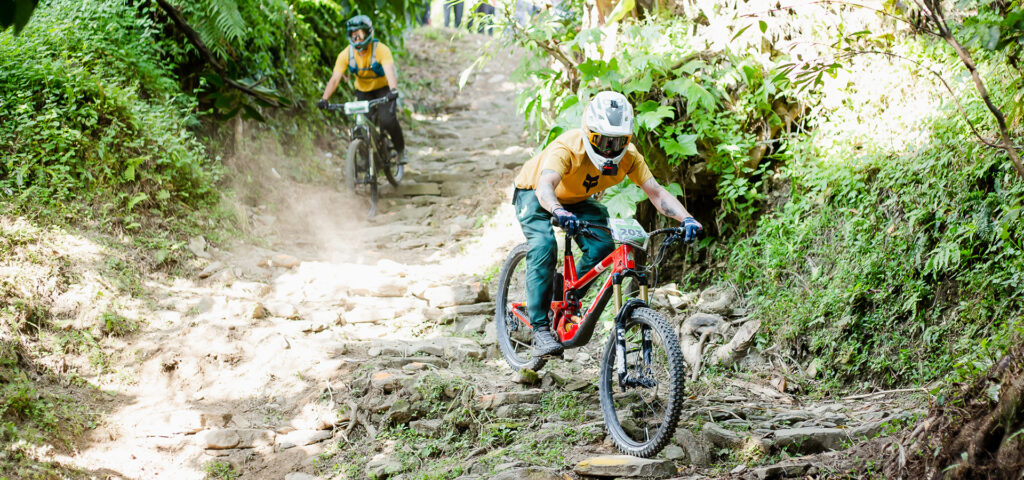
WHEN
08-14 December, 2026
WHERE
Mahaprabhu Dham, Arba
Pokhara-13, Nepal
4th Pokhara Enduro Race 2026 RACE CATEGORIES
1. Youth: For youth racers (12-16 years of age)
2. Junior: For youth racers (17-18 years of age)
3. Elite: For professional racers (males above 19 years of age)
4. Open Female: For professional racers (females above 18 years of age)
5. Masters-A: Between the ages of 30-39 (Male)
6. Masters-B: Between the ages of 40-49 (Male)
7. Veterans: Above 50 years of age (Male)

RACE ARENA
Arba Hills & Mahaprabhu Dham
The heart of the Pokhara Enduro beats in the Arba Hills, located just 7km east of the vibrant lakeside. Our race village is anchored by the spiritual serenity of Mahaprabhu Dham, sitting at a commanding 1,360 meters above sea level. This high-altitude launchpad offers more than just breathtaking views; it is the gateway to a world-class network of raw, natural singletrack.
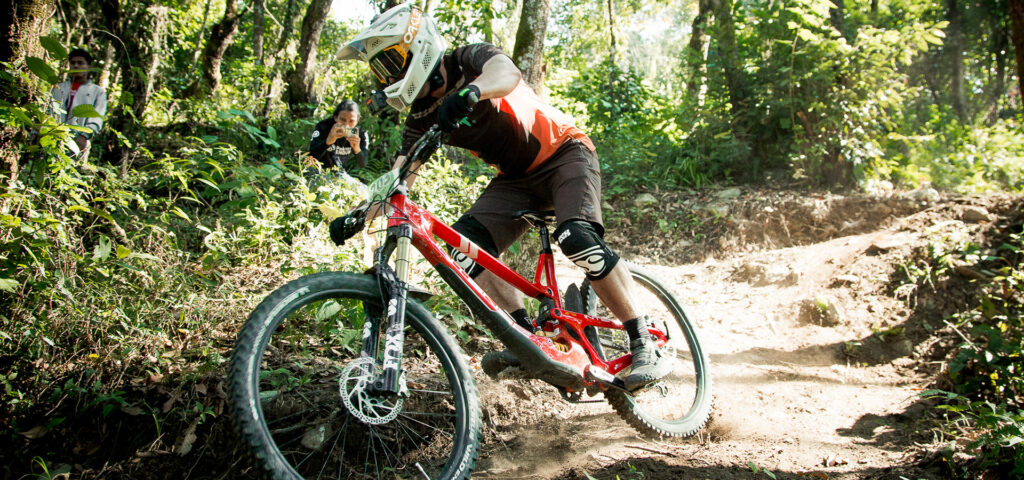
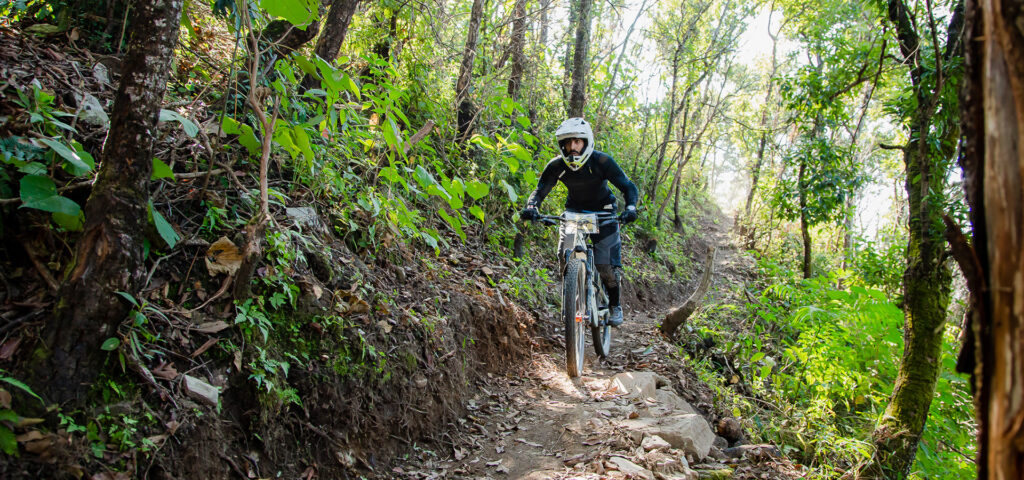
Carved through dense, sub-tropical vegetation, the Arba ridgelines offer a diverse terrain profile that is a dream for Enduro purists. Expect a masterclass in variety—from high-speed, loamy flow to technical, rock-strewn puzzles that demand absolute focus. The race naturally unfolds between two majestic river systems that fence the eastern and western flanks of the hills, creating a spectacular and definitive finish line for your Himalayan descent.
PLEASE PAY SPECIAL ATTENTION TO THE FOLLOWING RACE-RELATED
Important Information for the 4th Pokhara Enduro Race
Race Format
1-day practice: We will facilitate uplift for one practice day on all six (6) stages, plus one seeding stage of the special sections, to familiarise you with the new terrain.
Prologue: A prologue will be held on the second day to determine the racers’ sequence for the final race runs.
Important: The timing of the prologue run will be added to the overall race times.
2-day enduro race: mainly flat and climbing sections are untimed, and mostly descending sections are timed—2 to 3 hours of riding per day, with six (6) timed sections.
Race Transfer Stages
Riders will be transported up the hill to an assembly point each day. They can expect a starting transfer stage of easy uphill ridge riding for 0.8 km.
Uplifts by Vehicle
4-wheel-drive trucks will be provided to maximize the fun during practice day. Details of any uplifts will be provided during the race briefing. Come prepared to pedal on the race days in the authentic enduro riding style and spirit.
Protective Gear
WHAT KIND OF PROTECTION AND BIKE APPAREL DO I NEED?
- Helmets must be worn whenever a rider is pedalling. We recommend a full-face helmet, providing all-around protection. Helmets with a removable chin guard/piece are also acceptable. Knee pads are the other mandatory apparel (for timed stages). Another mandatory item is Riding Shoes. Other recommended apparel includes:
- Additional body armour (elbow pads, chest protector, back protector, etc.) according to the individual’s comfort level
- Padded shorts or bib shorts
- Full-fingered gloves
- Eye protection (sunglasses or goggles)
- Two or more sets of comfortable riding shorts + a jersey
Can somebody else register me?
No, you must register yourself, as we require your details and payment for confirmed registration.
How difficult will the race be physically?
The race’s difficulty level is Intermediate to Advanced; our race will fall between Blue and Red in the UCI Enduro grading system. The liaison sections climb, and the distance will fall into the one to two-bar category.
Apparels
As part of their packing list, all participants are advised to bring along the following:
- A storm-shell/waterproof jacket
- A synthetic insulated jacket or insulated fleece/wool mid-layer
- One or more insulated beanies/balaclava/headscarf
- A pair of sunglasses or goggles (with tinted lenses for bright sunlight). The recommended equipment includes (but is not limited to) the following:
- Warm gloves / Warm socks
- Spare clothing & sturdy walking/running shoes/flip-flops for casual hiking & sightseeing
- Lip balm/Sunscreen/Earplugs
- Head torch
- Baby wipes and/or antibacterial hand sanitiser gel
Insurance
DO I NEED INSURANCE TO TAKE PART IN THE POKHARA ENDURO RACE?
- Yes. The event passes through woods and hard-to-access areas. In an emergency, a costly means of evacuation may be necessary. All participants must have insurance covering this and any medical treatment that may be required.
- All successful international participants must present proof of insurance on the race briefing day (1st Week in Dec 2026). Anyone without adequate insurance will not be allowed to participate in the event.
4th Pokhara Enduro Race Rules – 2026
All participants must adhere to the following race rules
- The event is a mountain bike enduro race consisting of multiple timed stages, each timed separately. The Main Competition will consist of 6 timed stages conducted independently from the Seeding stage.
- Riders must complete all timed stages in the required order and as briefed by the race organiser.
- A) Riders will be equipped with electronic timing systems during the Seeding and Racing at the Pro Stage ( 11 December 2026) and the Main Competitions on 11 & 12 December 2026.
- B) Riders must only wear the provided timing transponders on the right wrist or arm. To prevent signal interference, please avoid using GPS or smartwatches on the right wrist.
- C) Riders are responsible for their discipline to ensure proper timing and to avoid accidental triggering of timing transponders. They must obey all instructions from start and finish officials to maintain a safe distance from the start and finish timing sensors. The minimum safe distance to avoid triggering is 3 meters. All time calculations are based on the first time a start/finish sensor triggers a transponder.
- D) Riders accept responsibility for the safekeeping of their timing transponders. Loss, damage, or destruction of a timing transponder by a rider will incur a penalty in the form of a replacement fee of USD 100 / NRS. 16,000 per transponder.
- The sum of the timings determines a rider’s ranking—also known as the ‘combined time’— and shall include the Pro-Stage and all Main Competition timed stages. Thus, all riders in the event are ranked accordingly, with the winner being the rider with the lowest combined time. Riders in a category where an attempt at the Pro stage is not applicable shall start separately from seeded riders; their combined timing and event rankings will also reflect this separation.
- Each timed stage will be predominantly downhill, though it may include some uphill sections.
- Riders will attain the start point of each timed stage via untimed or liaison stages, which are predominantly uphill. While the time taken to complete liaison stages will be logged, they are NOT included in the combined time used to determine the event rankings.
- Riders must follow a specific course and complete all stages in order. Before the race, riders are assigned practice sessions to preview the course and familiarise themselves with all timed and liaison stages. Not attending practice is not an acceptable reason for short-cutting the course or exceeding timings due to getting lost. Any deviation from the course—without a valid reason—will result in a time penalty.
- Riders queued to start a timed stage will be sent off with a minimum 30-second gap between riders. Riders not ready to begin within the 30-second window should remain in the rest area next to the queue and join the queue only when ready to race.
- If a rider exceeds the boundary of the timed stage (crosses/cuts the course marking tape), whether intentionally or unintentionally, they must re-enter the boundary of the timed stage at exactly the same point they first exceeded. Failure to do so will result in a penalty or disqualification.
- Bikes must conform to these specific regulations: they must have two independent working brakes, have the handlebar ends covered (no sharp edges at the ends exposed), and be deemed safe for use by a qualified bicycle mechanic, if necessary.
- Riders need to stick to the same bike throughout the race. If a rider needs to change any parts of the bike, it must be for a valid reason and must be approved by race staff without exception.
- Riders must wear appropriate safety gear during the race. Bicycle helmets are mandatory and must be worn whenever a rider is on a bike. Knee pads are mandatory and must be worn whenever a rider attempts a timed stage. Riding shoes are mandatory throughout the whole event.
- To ensure awareness of all event schedule timings and time limits, all riders must be equipped with a watch, GPS/smartwatch, GPS bike computer, or mobile/smartphone – without exception.
- The start list for the Seeding stage (11 December 2026), conducted on the Pro stage, will consist of the following categories in the following order:
- Elite Men
- Master A
- Master B
- Veteran
- Junior
- Youth
- Women Open
- These riders will be released at the Seeding Stage start according to a specific start time assigned to each rider at strict 60-second intervals.
The start list for the Main Competitions (11 & 12 December 2026) will consist of the following:
- Riders with the fastest to slowest seeding time (based on the result of Pro Stage/SS1) will be released in that order. They shall be released from the Event HQ onto the first stage on 11 December 2026, in this specific order. For the subsequent timed stages, riders need not maintain this order and can rest, queue, and start as they like (within the maximum event cut-off time).
- Riders with the fastest to slowest cumulated time (based on results of the first day of racing) will be released in that order for the second day of racing. They shall be released from the Event HQ (onto LS4) and queued to start SS4 (on 12 December 2026) in this specific order. For the subsequent timed stage (SS5 and SS6), riders need not maintain this order – and can rest, queue, and start as they like (within the maximum event cut-off time).